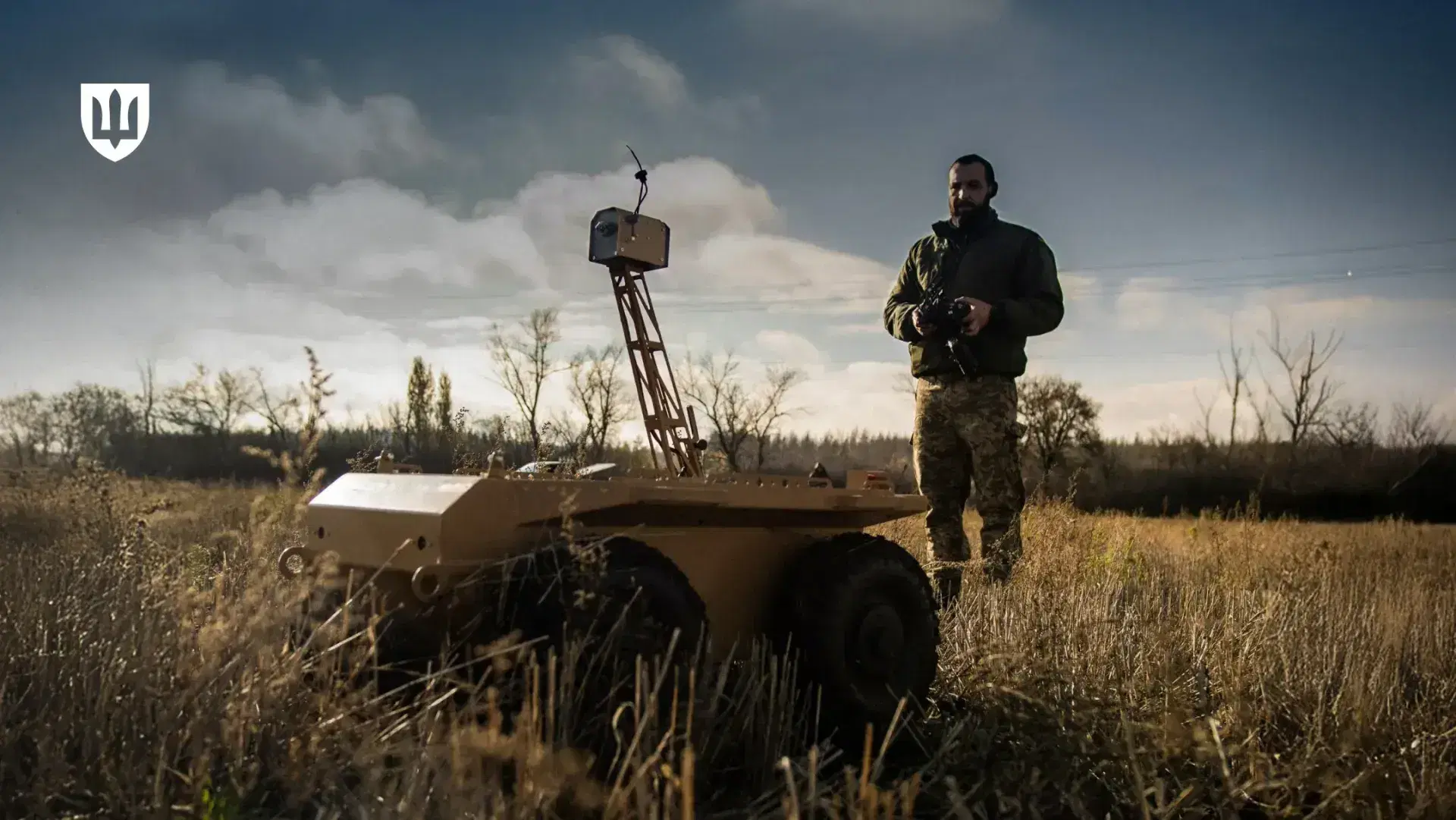
In today’s war, one truth stands out: machines must fight, not people. Technologies that only recently seemed futuristic are now integral to Ukraine’s Armed Forces, enabling complex missions while keeping troops safer.
Unmanned Ground Vehicles (UGVs) have evolved from simple transport trolleys into full-fledged battlefield participants, equipped with armoured capsules and secure communications. At the controls is a new-generation specialist — the operator of logistic and evacuation tracked or wheeled UGVs, classified under military speciality code VOS 129.
Lifesaving logistics: A UGV operator’s edge
A UGV operator is a soldier who fights, evacuates the wounded, and manages logistics using unmanned ground vehicles, all while staying out of immediate danger. Their work ensures enemy engagement, real-time logistics, and evacuation.
- Responsible for deploying and recovering UGVs (except kamikaze units).
- Ensures safe operation and functionality of the systems.
- Monitors performance, keeps machines running smoothly, and oversees timely maintenance.
Arsenal & equipment
The operator’s workplace resembles a high-tech control station. Their kit includes medium and heavy UGVs (tracked or wheeled), control consoles, ground stations, and secure laptops and tablets with navigation. Reliable power comes from batteries, charging stations, portable generators, and advanced communications gear — radios, antennas, and relays. Crews are also equipped with electronic warfare tools, repair kits, and tactical gear.
The platforms themselves are built for logistics and combat. Outfitted with day and night cameras, communications, and data channels, they take on highly demanding frontline tasks: striking enemy positions, remote mining, logistics, and evacuation. Heavy versions can carry up to 500 kilograms across rough terrain. Their battlefield role is expanding constantly — in some confirmed cases, UGVs have even forced enemy troops to surrender directly to an unmanned ground vehicle through phycological pressure and firepower.
Operators control their machines via consoles that manage movement, communications, and data transfer. Key features include ergonomic design, independent power, stable low-latency links, and protection against hostile interference.
Firearms are not central to the operator’s role, but remain vital for personal defence, securing positions, and safe evacuation.
Multi-level training
To master this new speciality, soldiers undergo rigorous preparation. After basic military training, they move to an intensive professional stage:
- Advanced tactical medicine.
- Training with hardware-software systems, navigation, and radio communications.
- Hands-on practice with UGVs of various types.
- Additional instruction in camouflage and auxiliary equipment.
Training is constantly refined. Today, unique UGV simulators are used in training centres, while theory can even be studied via the Army+ app.
Beyond the battlefield
Serving as a UGV operator means mastering some of today’s most advanced military technologies. It saves lives by enabling safe logistics and evacuation through unmanned ground vehicles. The expertise gained in MilTech opens doors for soldiers after victory — transferable skills for civilian robotics, logistics, agriculture, and humanitarian demining. In effect, the role equips service members with a ready-made profession as robotics operator engineers, in demand far beyond the battlefield.