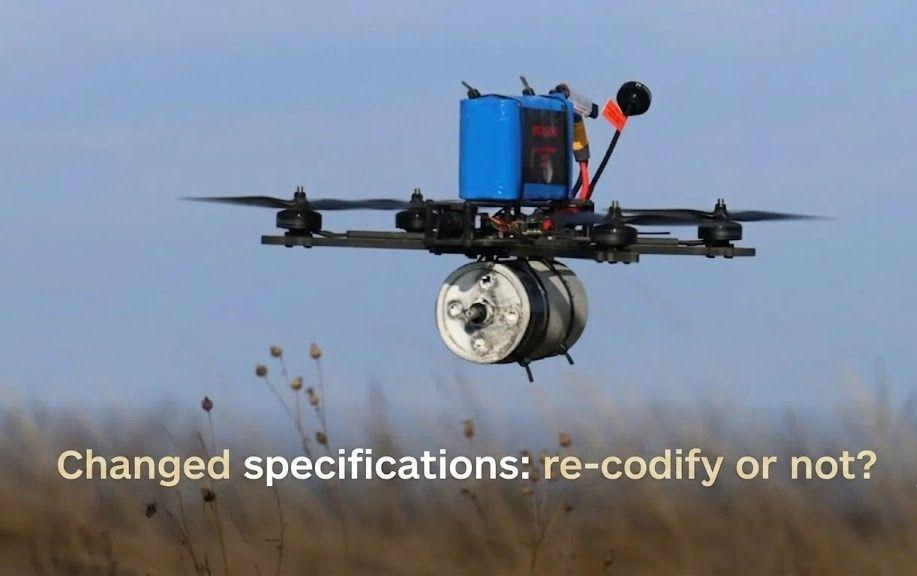
The Ministry of Defence has explained how manufacturers should formally document improvements to an already codified item of defence materiel.
A codified item of defence materiel is a product with defined dimensions, components, performance specifications, and operating conditions. These parameters have been verified and recorded. Yet, as warfare evolves, codified items gradually lose effectiveness – prompting the need for upgrades. Manufacturers modify items, enhance their characteristics and components. But how should these changes be documented?
Depending on the scope of modifications, there are three common options for formalising such changes.
Option 1: An item undergoes major design changes
For example, a UAV is fitted with a larger frame, more powerful engines, and a different type of communications and control system. As a result, the product’s performance specifications change significantly: it can fly further, carry heavier munitions, and exhibits different dynamic characteristics.
This is effectively a new item. It must be codified under an established procedure. The new UAV system will receive its own NATO Stock Number and may be supplied to the Defence Forces concurrently with the earlier, unmodified version.
Option 2: An item receives minor enhancements without design changes
For instance, a manufacturer equips a UAV with a higher resolution camera, a sturdier frame, and a lighter battery. Thanks to these adjustments, the UAV achieves a modest increase in flight range and slight improvements in dynamic performance.
The upgraded item must undergo standard tests to confirm its new specifications. Based on the test results, the manufacturer is required to prepare Protocols, endorse them with a Certificate, and issue a Notification of Change to the Technical Specifications. These documents must then be submitted to the authority that originally registered those specifications.
In this case, the NATO Stock Number of the improved item does not change. The upgraded version is recorded under the existing code. However, the earlier, unmodified version can no longer be supplied to the Defence Forces.
Option 3: An item uses replacement components of equivalent specifications
For example, a UAV previously fitted with a battery from company A is now equipped with one from company B. Or, where it once used polycarbonate propellers, the manufacturer has switched to nylon. In both cases, the performance specifications of the components — and of the UAV overall — remain unchanged.
In such circumstances, the manufacturer must carry out an incoming inspection for the purchased components. This means confirming that the specifications of company B’s battery genuinely match those declared by the manufacturer.
If the technical specifications for the item explicitly named the battery’s manufacturer, then a Notification of Change to the Technical Specifications must be issued. If, however, the technical specifications only listed the performance specifications of the battery or propeller — and these have not changed — then no notification is required.
In both scenarios, the improved item retains its existing NATO Stock Number.