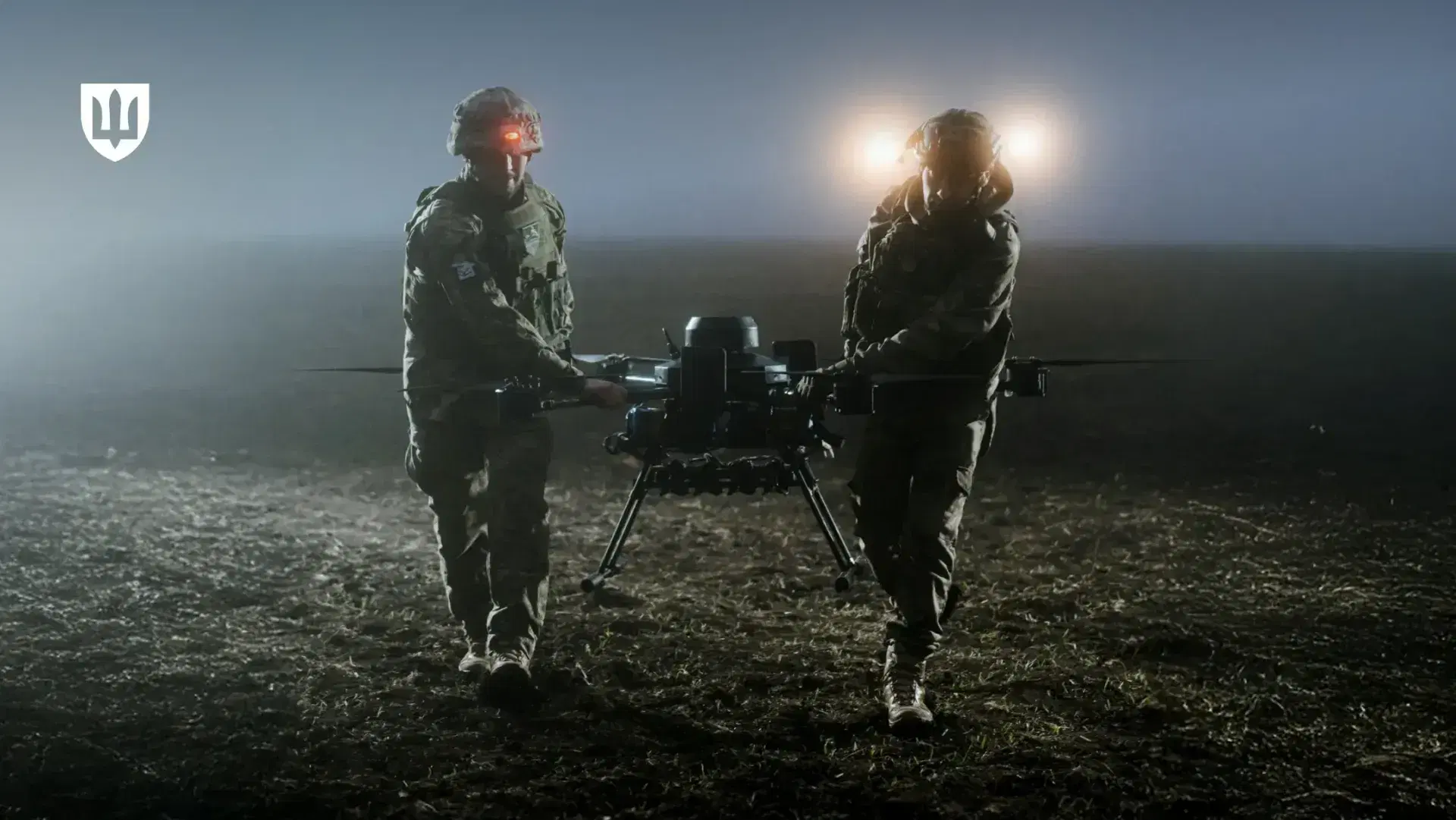
Heavy multirotor drones have become one of the most effective weapons against russian armour, ammunition depots, and supply routes.
On the battlefield they appear mostly at night, earning from the enemy the fearful nickname “Baba Yaga.” At the controls of this airborne artillery is the operator of a heavy bomber UAV, classified under military speciality code VOS 217.
Gaming with the highest stakes
A heavy bomber operator pilots a large strike-drone from a safe distance behind the line of contact. The process is often likened to a computer game: crews work with specialised software, navigate through onboard cameras — most often thermal imagers — and carry out precision bomb drops in real time.
But behind the analogy lies immense responsibility and risk. The crew’s tasks are to:
- covertly guide the heavy drone onto enemy positions
- detect camouflaged vehicles, bunkers, or logistics hubs
- deliver accurate strikes and return the drone safely for reloading.
These specialists inflict maximum damage on the enemy while preserving what matters most — their own lives and those of the infantry they support with aerial firepower.
Technological Arsenal: From Vampire to Nemesis
Ukraine is a global leader in the development and combat use of heavy copters. Domestic systems such as Vampire, Kazhan, and Nemesis are actively deployed by the Defence Forces.
These are massive hexa- or octocopters, with six or eight rotors, capable of carrying payloads from 10 to 40 kilograms. That capacity allows them to deliver anti-tank mines or specially designed fragmentation munitions.
The crew’s kit includes:
- a secure ground control station (tablet or laptop with consoles)
- satellite communication terminals (Starlink) and external antennas
- powerful autonomous power systems (generators, charging stations, large UAV batteries)
- a transport vehicle, usually a pickup, for rapid deployment and evacuation.
For personal protection, crews are armed with standard firearms, essential for guarding launch positions.
Training: Night navigation and handling explosives
Flying a heavy bomber demands jeweller’s precision. These large machines are highly wind-sensitive and carry significant loads. Training begins with basic military preparation — tactics, medicine, and weapons handling — before progressing to intensive specialist courses in piloting.
At this stage, operators learn to keep bulky drones stable in the air, manoeuvre with payloads, and perform complex ballistic calculations for bomb drops.
Since most missions are carried out at night, training places special emphasis on optics. Future operators practise rapid, accurate target recognition through thermal imagers and night-vision devices. Another crucial element is sapper training and safety: bomber crews constantly work with powerful explosives, requiring strict instruction on handling munitions and securing them to the drone’s release system.
A Profession with a Future
Operating heavy drones builds advanced skills in managing cargo UAVs — a field now expanding rapidly worldwide. After service, these specialists will be in high demand across several well-paid civilian sectors, particularly agriculture and logistics.